The Texas People Imagine, and the Texas That Actually Exists
Ask someone who has never been here to describe Texas and you will get a fairly consistent picture. Cattle and oil derricks. Boots and belt buckles. Wide, flat, hot, and culturally uniform. A place with one accent and one point of view.
That Texas exists. You can find it, and parts of it are wonderful. But it describes maybe a tenth of the state, and almost none of the twenty-two million people who live in its metropolitan areas. The Texas that actually exists is one of the most demographically complex places in the Western Hemisphere, and it has been a meeting point of empires and migrations for three hundred years.
If you are considering a move here, that gap between the postcard and the place is worth understanding. It explains more about daily life than any list of restaurants could.
The Name Is the First Clue
Texas takes its name from tejas, a Spanish rendering of a Caddo word meaning something close to friend or ally. Spanish expeditions in the seventeenth century encountered the Caddo confederacies of what is now East Texas, heard the word used as a greeting, and applied it to the territory.
The state motto today is a single word: Friendship. It is not marketing. It is a translation.
That etymology sits oddly against the state’s reputation for swagger and self-sufficiency, and both things are true at once. Texas is genuinely proud and genuinely welcoming, and the tension between those instincts has run through its entire history.
Texas Was Not Always American, and Not Even Mostly
Here is the fact that reframes everything else: Texas has been part of the United States for about 180 years. It was Spanish territory for roughly 130 years before that, and Mexican for 24 more.
The sequence matters:
Spanish Texas. Spain claimed the region in the 1500s and began settling it in earnest around 1690, establishing missions and presidios across what is now East and South Texas. San Antonio de Béxar was founded in 1718. For well over a century, the governing language, legal system, and land tenure here were Spanish.
Mexican Texas. When Mexico won independence from Spain in 1821, Texas came with it, administered as part of the state of Coahuila y Tejas. The new Mexican government wanted the sparsely populated north settled, and it opened the territory to immigrants.
Those immigrants were Anglo-Americans. Stephen F. Austin’s Old Three Hundred — the families who first colonized under his grant — were, in the plainest terms, foreigners moving to Mexico. They took Mexican land grants, swore allegiance to the Mexican republic, and were required to convert to Catholicism. The first large wave of English-speaking settlers in Texas arrived as immigrants seeking opportunity in someone else’s country. It is worth sitting with that, given how the state’s relationship to immigration is discussed now.
The rupture. Relations soured over the 1820s and 1830s, for a tangle of reasons: centralizing power in Mexico City, cultural and religious friction, tariffs, and the fact that Mexico had abolished slavery in 1829 while the Anglo colonists’ cotton economy depended on it. The Texas Revolution of 1835-36 produced the Alamo, San Jacinto, and an independent Republic of Texas.
Annexation and war. The Republic lasted nine years. The United States annexed Texas in 1845, and the boundary dispute that followed helped trigger the Mexican-American War. The Treaty of Guadalupe Hidalgo in 1848 transferred roughly half of Mexico’s territory to the United States — not just Texas but California, Nevada, Utah, and most of Arizona and New Mexico.
That is the pivot point. It redrew the map of North America, moved an international border across communities that did not move themselves, and set the terms for the relationship between the United States and Latin America that we are still living inside.
The Past Is Not Past Here
Spanish and Mexican governance did not simply end in 1848. Much of it is still operating, quietly, underneath modern Texas.
Texas is a community property state. That comes directly from Spanish civil law, not from English common law, which governs most of the country. If you are married and buying a home here, the way ownership vests between spouses follows a Spanish legal tradition. Buyers relocating from common-law states are frequently surprised by this at the closing table.
Texas homestead protections are among the strongest in the nation. The Republic of Texas passed a homestead exemption law in 1839, the first of its kind in the United States, protecting a family’s home from most creditors. Legal historians generally trace the concept to Hispanic legal traditions that valued keeping families on their land. Today it is why Texas homestead law is unusually protective, and why your homestead exemption meaningfully reduces your property tax bill.
The map is a Spanish map. San Antonio, El Paso, Amarillo, Laredo, Refugio, the Brazos, the Nueces, the Guadalupe, Palo Duro. Fort Bend County alone holds Rosenberg, Richmond, and Sugar Land alongside older Spanish and Mexican land grant boundaries that still shape property lines.
You are not moving to a place with a Hispanic influence. You are moving to a place with a Hispanic foundation that later acquired an Anglo-American superstructure.
What the Numbers Say Now
Texas passed a milestone in 2022 that had been approaching for decades. Census estimates confirmed that Hispanic Texans became the state’s largest population group for the first time since at least the 1850s — 40.2% of the population against 39.8% non-Hispanic white. Black Texans account for roughly 13% and Asian Texans roughly 6%.
Among Texans under 18, the Hispanic share is close to half. Hispanic students have made up a majority of Texas public school enrollment for more than a decade. Whatever Texas looks like in 2050, it is already visible in its classrooms.
The state is also still growing faster in absolute terms than anywhere else in the country. Texas added 391,243 residents in the year to July 2025 — more than any other state — bringing the total to 31.7 million. That growth has moderated: net international migration to the United States fell by about 55% nationally in 2025, and the number of immigrants moving to Texas dropped by roughly 48%. Domestic migration also cooled sharply from the peak years earlier in the decade. Texas is still adding people at scale, but the composition and pace of that growth are shifting.
Houston Is the Sharpest Version of the Story
If Texas is a mini America, Houston is the concentrated form of the argument.
Rice University’s Kinder Institute has documented the Houston metro as the most racially and ethnically diverse in the country, surpassing New York and Los Angeles. Roughly 145 languages are spoken across the metro. After English, Spanish is by far the most common at home, followed by Asian and Pacific Islander languages and other Indo-European languages.
What is striking is how quickly this happened. In the 1940s Houston had fewer than 600,000 people, segregated schools, and segregated neighborhoods. The transformation into the country’s most diverse metro took roughly two generations.
And it is no longer just an inner-city story. The Greater Houston Partnership’s recent analysis found that Fort Bend County has now edged past Harris County as the most racially and ethnically diverse county in the region, with the highest share of foreign-born residents at 30.7% — a majority of them from Asia. In Fort Bend, Liberty, and Waller counties, more than one in three residents speaks a language other than English at home.
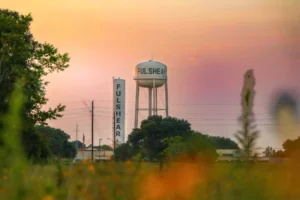
Anyone who has spent time in Sugar Land, Katy, Missouri City, or the newer communities out toward Fulshear already knows this. The suburbs did not dilute Houston’s diversity. They absorbed it and extended it.
The Honest Version of “Mini America”
The phrase gets used loosely, so it is worth being precise about what is and is not true.
Texas is genuinely a place where the whole American range coexists in one jurisdiction — a rural West, a Deep South east, a border culture in the south, and global metropolitan centers that look like nowhere else in the country. It contains multiple economies, multiple political traditions, and communities from essentially every part of the world.
It is not a place without friction. Growth on this scale strains roads, water systems, schools, and housing supply. Kinder Institute survey work has consistently found that Houstonians from different backgrounds report quite different experiences of opportunity and of relations between groups, and that gap is real. Texas is a place of active negotiation, not settled harmony.
But the negotiation itself is the point. This is a state that has been absorbing newcomers, in waves, from different directions, for three centuries — Spanish, Mexican, Anglo-American, German, Czech, African American, Vietnamese, Nigerian, Indian, Salvadoran, Pakistani, Chinese. The absorbing is not a recent development or a departure from what Texas is. It is the oldest continuous thing about the place.
Why This Matters If You Are Moving Here
Practically: the Texas you are moving to is not culturally uniform, and where you land inside it matters enormously. A community twenty minutes apart from another can differ in language, food, worship, school composition, and daily rhythm. That is a feature, but only if you choose deliberately rather than by floor plan alone.
Our own team is part of this story rather than an observer of it. That is not unusual here. It is close to the norm.
If you are relocating to the Houston area and trying to understand not just what homes cost but what living in a particular community actually feels like, that is the conversation we most enjoy having.